
Ebook Download Games Criminals Play: How You Can Profit by Knowing Them
Discovering this Games Criminals Play: How You Can Profit By Knowing Them as the ideal publication really makes you feel eased. Even this is just a book; you could locate some benefits that can not be obtained from any other resources. Satisfying the interested it is at some point really easy, yet at some point it requires the big effort. As here, prior to locating this site to obtain the book, you might feel so baffled. Why? It's because you really require this incredible publication to review as soon as possible.
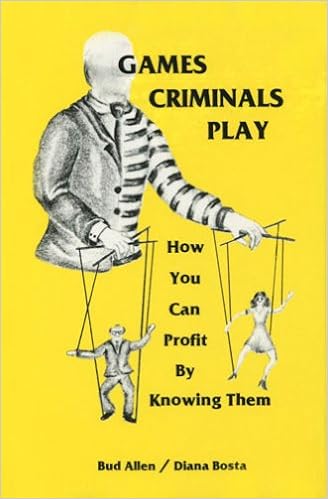
Games Criminals Play: How You Can Profit by Knowing Them

Ebook Download Games Criminals Play: How You Can Profit by Knowing Them
Games Criminals Play: How You Can Profit By Knowing Them. The established technology, nowadays support every little thing the human demands. It consists of the daily tasks, works, workplace, enjoyment, and a lot more. Among them is the excellent net connection and also computer system. This problem will ease you to sustain among your leisure activities, reading practice. So, do you have going to read this e-book Games Criminals Play: How You Can Profit By Knowing Them now?
This is among the methods when you have no fiend at that time; make guide as your true friend. Also this is not kind of talk-active point, you can make new mind and get brand-new ideas from the book. From the literary book, you could acquire the home entertainment as when you enjoy the film. Well, talking about the books, really what type of book that we will advise? Have you heard about Games Criminals Play: How You Can Profit By Knowing Them
Somebody will constantly have factor when using often. As right here, we also have numerous sensible advantages to take from this book. First, you can be one of the hundreds people who read this Games Criminals Play: How You Can Profit By Knowing Them, from several locations. After that, you can obtain a very simple method to find, obtain, and also read this publication; it's presented in soft file based upon online system. So, you could review it in your gadget in which it will be constantly be with you.
Gather guide Games Criminals Play: How You Can Profit By Knowing Them begin with now. But the new means is by accumulating the soft documents of guide Games Criminals Play: How You Can Profit By Knowing Them Taking the soft file can be conserved or stored in computer or in your laptop computer. So, it can be greater than a book Games Criminals Play: How You Can Profit By Knowing Them that you have. The most convenient way to disclose is that you could also save the soft documents of Games Criminals Play: How You Can Profit By Knowing Them in your ideal as well as readily available gizmo. This condition will intend you too often check out Games Criminals Play: How You Can Profit By Knowing Them in the leisures more than chatting or gossiping. It will not make you have bad habit, yet it will lead you to have better behavior to check out book Games Criminals Play: How You Can Profit By Knowing Them.
100% Satisfaction is Guaranteed! There are no problems in page content and in the paper. You will be the first to open the book cover. For Used condition books in our store; It shows signs of wear from consistent use, but it remains in good condition and works perfectly. All pages and cover are intact , but may have aesthetic issues such as price clipping, nicks, scratches, and scuffs. Pages may include some notes and highlighting. For all our books; Cargo will be delivered in the required time.
Read more
Product details
Hardcover: 228 pages
Publisher: Rae John Pub Co; 1 edition (August 1, 1981)
Language: English
ISBN-10: 0960522603
ISBN-13: 978-0960522606
Product Dimensions:
6.2 x 0.8 x 9.2 inches
Shipping Weight: 14.4 ounces (View shipping rates and policies)
Average Customer Review:
4.6 out of 5 stars
268 customer reviews
Amazon Best Sellers Rank:
#50,910 in Books (See Top 100 in Books)
This book is valuable for anyone thinking of working in a prison. It offers two significant benefits.ONE: it articulates, in great detail, the risk of becoming a victim of manipulation by prisoners. It shows how to avoid this danger.TWO: Reading the book is an exercise in sorting out correctional staff's practice wisdom from their punitive fear mongering.ONE: when members of the public think of the risks of working in prison, they imagine physical violence. In my experience, more correctional employees are manipulated into breaking rules and violating laws than suffer physical attacks. As best I can tell, more employees are "walked off," than are beaten or stabbed. The risks of physical injury or death are real, but can be mitigated by simple precautions. Preventing manipulation requires much more subtle work. This book does a solid job of showing how crooks do it, and how employees can immunize themselves to this risk.Victimizers target potential victims by observing appearance and body language. They look for staffers whose dress and grooming betray discomfort in their own skin. They look for employees who are unhappy, frustrated, resentful, fearful. To check out these initial impressions, they test for willingness to let minor rules violations slide and to permit petty breaches of personal boundaries; using first names, brushing against the employee, floating sexual innuendos.If the employee does not put a stop to these probes, the grooming begins in earnest. The staffer's unmet emotional needs are addressed. The employee with low self esteem is flattered. The victimizer lets him know how fascinating and wise the staffer is. The resentful employee is assured that management does not appreciate him the way the prisoner does. The staffer's sympathies are aroused by hard luck stories. The frightened staffer is assured the victimizer will make sure nothing happens to him.Then the employee is inveigled into moving from toleration of minor violations to committing violations himself. The employee who shared his sandwiches is induced to bring in extra goodies. He is asked to mail letters that would not get past the prison censors. He asked to make unauthorized contact with the prisoner's family.At some point the employee becomes afraid to let management know he has broken so many rules. He is isolated from other staff. Now the trap is sprung.The employee is blackmailed into bringing drugs into the prison or into performing sexual favors. One officer was so deeply compromised that he brought in a uniform, piece by piece, until the prisoner had a full uniform and was able to escape.The authors provide specific directions on how to keep from becoming a victim. The employee must set clear, firm, consistent limits. The employee must refuse to be isolated from the rest of staff.Most critically, if the employee has been sucked into this vortex, he must let administration know. To my knowledge, absent a major felony or security breach, the worst that happens to an employee who turns himself in is loss of some pay and a temporary demotion. Most often, the employee receives a reprimand or caution. Hiring and training a new employee is time consuming and expensive. Management generally prefers a sadder and wiser employee to an untested new one.The employee who fails to tell on himself winds up getting fired. He loses his job pension. If the violation is flagrant, he may be prosecuted. He is humiliated. It is an insidious process; I knew several employees whose overfamiliarity led to their dismissal. None had believed it could happen to them. None saw it coming, no matter how hard I, and other colleagues, tried to tell them.The authors' greatest strength is their empathy with the victims of manipulation. They grasp fully what it is like to start out wanting to do the right thing, but end up committing crimes one would never have imagined preforming unprompted.TWO The book does an excellent job of showing how correctional staff can be manipulated into breaking rules and into violating laws. Unfortunately, the book also fosters a punitive agenda. By inducing global, ultimately paralyzing, fear, the authors manipulate readers into betraying their own highest values.In this book, fear is promoted by omission. The authors say that staff are vulnerable to manipulation if they are too "soft," or too "hard," but all examples are of staff who are too permissive or lenient. There are no examples of staff whose harshness and rigidity masks an underlying sense of personal inadequacy, which a con artist can exploit.The authors state that not all prisoners try to manipulate staff; many are trying to turn their lives around. They then provide only one example of a prisoner making an appropriate request of staff. That example is weak and ambiguous. It is not helpful.The authors clearly know their subject. None of their vignettes looks fabricated. All examples present scenarios a correctional employee can expect to face. I believe that had they wanted, they could have provided many examples of prisoners who relate appropriately to staff. The authors could have explained that these prisoners do not ask staff to break rules or laws. They do not make spurious offers to make the employee's life easier or ask the employee to run errands. Their interactions with staff are clearly part of the prisoner's effort to "turn his life around."Providing such examples would have helped readers distinguish between prisoners who are "programming," from those who are manipulators. The authors could have offered guidance on how to respond effectively to prisoners who are trying to make positive changes in their lives. It is true that a prisoner who presents this way may be an extremely clever manipulator; I believe the authors had the knowledge and experience to help readers tell which prisoners are sincere and which ones not when they ask for help changing for the better.Had they given as many examples of prisoners making positive changes as they did of prisoners manipulating staff, they then would have written a book that was balanced and genuinely helpful to staffers. Instead, they wrote a one-sided book, which instead of helping staffers deal confidently with prisoners, provokes fear; fear so pervasive that it corrodes the will.Here is one clear example. During orientation this book was used to justify telling new employees that we should have no empathy for prisoners. I had not yet read the book, When I did read it, I discovered that the presenter had misunderstood what it does say about empathy, but he had grasped its general tenor.I found the directive not to have empathy appalling, and shared this sentiment with several colleagues. To my surprise, they all agreed that it would be dangerous to have empathy with members of this population.In response, I askedI of what disorders is the absence of empathy a defining characteristic. My colleagues knew: antisocial personality disorder, sociopathy, psychopathy. They knew this full well. I was not telling them anything they did not know. The fear instilled in them by the Department of Corrections had driven them to abandon one of their core values.The Department had also made them less safe. If empathy is understanding what it feels like to be another person, would it not be safer to know what it feels like to be a prisoner than to insist on remaining ignorant of that perspective?If the authors had valued empathy for prisoners as much as the do for staff, they would have written a masterpiece. As it is, their book is an incomplete, middling effort.
As a newcomer to the corrections profession, I've found this text immensely handy. It was almost surreal how I'd come home from one of my first days on the job and flip open the book and read about the very kind of manipulative scenario I had been confronted with that day. Its helped me establish my own personal set of standards that will remain unchanged no matter how my peers may lower theirs. Its been slow and rough, but I am encouraged and seeing results with inmates recognizing that I'm firm, but fair. I'm careful to guard what information I share, and evaluate carefully if certain conversations are appropriate or if something I'm saying is giving them ammunition to hunt me with later. There are some spoiled inmates that don't like that I'm not letting them have their way, but I've seen the relief its been for other inmates to be able to count on me to enforce the rules.
I read this after working in corrections for almost a decade. I wish it had been assigned to me during my first week. Although it was written many years ago and in some examples appears dated, the wisdom it contains is timeless. I was not a correctional officer; I provided mental health services to inmates, so my corrections 'wisdom' came in two forms. I was formally trained in inmate manipulation by the "white-shirts" (prison administrators) and shown examples by the "brown-shirts" (front line officers who actually deal with inmates for up to 16 hours a day).This book connects the two sources of wisdom, and breaks it down into terms that a "newbie" can understand and relate to. By the time I read "Games Criminals Play" I already knew the basics, and I knew how to spot, and avoid, manipulation. This book teaches us how to see manipulation BEFORE it becomes obvious, and it explains the "hinky" feelings that result from attempted manipulation.A new corrections employee has to learn how to do three jobs: 1) The job he/she was hired to do, 2) learn inmate behavior, and 3) understand the corrections culture. The lives of corrections staff depend on how well, and how quickly, they learn. "Games Criminals Play" has saved both lives and careers, and will continue to do so.There is no equivalent to the advice of a well-seasoned corrections officer. Inmate knowledge is gained through experience. In my experience, at least a year is required to safely understand the risks and consequences of inmate manipulation. "Games Criminals Play" is immensely helpful in making that first year, and subsequent years, safe. Highly recommended for everyone, because a large percentage of criminals are not arrested, convicted or incarcerated. The wisdom contained in "Games Criminals Play" applies to bosses, spouses, kids, and the general public. The stakes are usually not as high as in a prison, though.
Its a little cheesy and dated but if you work in ANY capacity in ANY kind of correctional facility or criminal justice service area, you especially need to read this book or something like it. Dont be that employee who gets hustled into a sexual relationship, into bringing in contraband, or into giving up little things like a stick of gum to a convict. Youre job, your self esteem, and your reputation isnt worth the trouble that causes.
Games Criminals Play: How You Can Profit by Knowing Them PDF
Games Criminals Play: How You Can Profit by Knowing Them EPub
Games Criminals Play: How You Can Profit by Knowing Them Doc
Games Criminals Play: How You Can Profit by Knowing Them iBooks
Games Criminals Play: How You Can Profit by Knowing Them rtf
Games Criminals Play: How You Can Profit by Knowing Them Mobipocket
Games Criminals Play: How You Can Profit by Knowing Them Kindle


Tidak ada komentar:
Posting Komentar